Saturday, October 15, 2016

The 'locker room' speaks...

The US presidential election has been stirring something in me for a long while now. I was struggling to put a finger on it, till it distilled, with Trump's so-called 'locker room' talk. I wondered, earlier, if the election stands for what seems rather obvious: Democrat versus Republican ideologies, man versus woman and so on, till the 'locker room' stuff laid it bare. In his own obnoxious way, Trump served to haul out of the closet, for the world at large, what was deemed unspeakable. Under the guise of equality, education, social and political correctness, we have feared to name some inner wars that have raged in our minds and therefore on our planet. 
There is the ubiquitous rage of girls and women - and boys and men - against their molesters and rapists. But there is also the silent simmering of those that allow sex willingly, for the sake of money, convenience or simply because they believe they do not have a choice.
There is the overt anger of the poor against the rich, protesting the inequity of things. But there is also the imploding frustration of having lived with one's poverty (of money, love or anything else) and having spent a lifetime fighting against those that have, instead of fighting for what one could create.
There is the stress and breakdown and burnout after living a professional corporate life that does not permit emotion and softness. But there is also the wrecking guilt of not having challenged that reality and not questioning what is deemed to be professionally acceptable.
There is the numbing fear and anger about the destruction caused by terrorism. But there is also the deep shame of the weaponless terrorist in us that manipulates the world around us, unless they give in to our demands.
There is the sorrow and depression and fear connected with being a failure in the eyes of the world. But there is also the overpowering sense of truth in knowing that success is different for everyone, and yet, not standing up for oneself and voicing it.
Trump has brought out for the world, the primal nature of our universe in all its glorious nakedness: wearing only its polarities. In trying to be 'good', 'moderate', 'politically correct', 'diplomatic'... and all the other things we try to be, to be socially acceptable, we collectively pushed into the shadows the overarching truth, that the universe as we experience it in the human form has a dual nature. There is positive and negative, minus and plus, male and female, bad and good. In the name of tolerance, shame and social correctness we pretended to walk the middle ground for a long time, trying to transcend the polarities, 'fitting in'.
And now, it is laid bare. And we are asked to vote. Good or bad? Right or wrong? Judgmental or non-judgmental? 
It is not just about the President of the US. It is about what will preside in us. And it is not a one-time vote. It is a vote we need to cast every moment of our existence. Are we ready to engage our polarities, and not transcend them? Are we willing to acknowledge all that we are - a fascinating mess of possibilities - and consciously choose a stance for every moment of our lives? Sometimes it serves to be good and sometimes the bad helps too. To some I am an angel, others learn from the devil in me.
This is way beyond the elections. Are we, as humanity, ready to vote for conscious living, over and over again?

Saturday, September 17, 2016

Light and Dark - In Union


When the candle dwindled
And began to merge
With where it began
The floor lit up in union.
The darkest place
Was no longer under the candle.
In oneness
There is only rejoicing light.
And then
The satiated dark
That no longer fights
The light it was born out of.

Wednesday, August 17, 2016

An Intent for Freedom and Oneness


Taking off from Rabindranath Tagore, on India's 70th Independence Day on 15 Aug 2016... The beauty in the verse is his, the blemishes are mine...
Where the mind needs no borders and the planet is free
Where passports are no longer in existence
Because we belong everywhere
Where families come about through the depths of our hearts
And not because there are institutions that tie us together
Where the clear voice of oneness guides our way
As we labour, in love of our world
To create beauty, simply to celebrate who we are
Into that home of freedom,
Let my being awake.

Sunday, March 08, 2015

Happy Women's Day, Man!

In the last few months, I have heard men communicate through media their expectations about us Indian women, including:

- The number of children we must produce
- What we ought to wear
- When must we return home in the evening
- The technology we should not use
- The gender we could be friends with
- The ideal response in case we are in the process of being raped


Once I overcome my initial judgment of disdain and disgust towards the men who make these statements (and the women who support them), I am aware of the huge sense of powerlessness in these men. This lack of power is so overwhelming that it makes them beg, borrow and steal it from the women around them, who in their eyes, is supremely powerful. And why not: she can give life, nurture it, be beautiful, be professional, celebrate her myriad roles and her sexuality and rule the world. The power of her womb fuels humanity.


Yes, man, I understand your powerlessness. You have no womb. However, you were formed in one. You will always have the womb energy of your mother available to you, should you choose to access your power. 


If you want to feel powerful, have the courage to nurture those around you, knowing that one day they will force their way out of this nurturing womb, tearing you in the process; but you will have co-created life.


If you want to experience power, accept the cycle of the womb and be brave enough to welcome pleasant emotions and unpleasant feelings. The womb is wise, it flows with the rhythm of the universe and knows that destruction is the first step of creation.


If you want to know your power, learn to respect choices. The womb does not grudge the choice of an unfertilised egg; it purges it and relentlessly moves on to release another egg in the next cycle. When a woman says no to you, man, learn to respect it. Rejection of your overtures does not make you small. What makes you small is your inability to accept the response.


No matter how much you try to control and force us, man, you will not be powerful. We women are powerful because we celebrate the woman in us by claiming our power, as much as we express the man in us through love. You, man, need to claim yourself first. Be man enough to love. And then, access the woman in you and dare to nurture, trust and respect. You will then know power.


Here’s to the woman in you, man… Happy women’s day! You need this day more than we do.

Friday, January 30, 2015

What did you die for, soldier?


This poem is a tribute to Col MN Rai of the Indian Army, and thousands of others soldiers who die around the world, hopefully believing a worthy cause. Col Rai’s daughter bid him farewell with the battle cry of his regiment. It made me wonder, will she grow up wanting revenge, or peace?

What did you die for, soldier?
Was it for your daughter
Who bid you farewell
With the battle cry of your regiment?
Was it for your fellow soldiers
Who responded to your daughter’s cry
And stood with her in solidarity?
Was it for the country
That decorated you with a medal
For guarding its borders?
Was it for me
A citizen you never knew,
Who wonders where her loyalties lie?
Am I disloyal to you soldier,
If I have friends across the border
And whose children are dear to me as my own?
Am I disrespecting you soldier,
For sharing a dream with these friends
For a borderless world?
I applaud your commitment soldier
But forgive me, I do not understand
What you were committed to.
Was it for a concept called India
Or against an idea called Pakistan?
I am proud of the land I come from
I am grateful to the Earth and her resources here
For making us who we are.
I am a product of the people of this land,
Cradled in its culture and nurtured in its values.
I am proud to claim my Indianness.
But forgive me, soldier
If my Indianness does not reject other identities.
I am sorry, soldier
But my loyalties do not lie
With two governments keeping a war alive
For reasons I cannot comprehend.
Did you die for the India in me, soldier
Or for the idea of India that is at war
Against a concept called Pakistan?
Countries are but notions
We created to embody ideas we reject in us
Are we a race that glorifies killing each other
Over mere ideas we do not accept?
I have a conundrum in me and no answers
But I pray that you rest in peace, soldier.
I hope, in your death,
You have given life to an idea of peace
In your daughter who cries for you.
I hope she learns to overcome
The idea of borders that killed you.

Friday, December 19, 2014

To You, Who Killed...

(This poem is addressed to the terrorists who perpetrated the attack on children at Army Public School, Peshawar, Pakistan on 16 Dec 2014, killing more than 130 young students.)


You, who methodically shot innocent children
Even as they trembled in terror and begged for escape
You, who thought nothing of revenge
Even if it meant unimaginable brutality
You, who want the world to cower in fear
Even as the world cannot understand your act
What hurt you so, that you had to kill?
What made you feel so unheard
That you had to make us listen
Through the heart-rending wails of grieving mothers?
What made you feel so rejected
That you had to find a voice
Through the silent pain of benumbed fathers?
Why do you feel so unseen
That you had to prove your presence
By replacing parents’ dreams with nightmares?
I do not have it in me to blame you.
Perhaps, I created you too
By ignoring those beyond my little world.
I cannot bring myself to condemn you.
Perhaps, I killed dreams too
By refusing to engage with the peripheries of my life.
I do not want to punish you.
Perhaps, I marginalised you
By labelling you as undesirable.
I stand in grief.
I mourn in pain.
But I know not, if the grief and pain
Are for the lives lost through those little ones
Or for the lives in you that still stand ostracized.
Did some mother not nurture you in her womb
And dress you with care as she sent you to play?
Did some father not work a little harder
To earn that extra penny for your future?
In killing those children
You bereaved your parents.
They lost you to your choices.
How do we find you back
And integrate you in us?
How do we stop rejecting you
So that terror is not your only option?
Talk to me, abandoned child.
The lost lives tell me,
I cannot heal death with more death.
Are you willing to give life a chance?

Friday, September 05, 2014

A Conversation with Evolution

(This blog was originally published at http://www.masterpeace.org/blogs/post/a_conversation_with_evolution)

(Note: The term ‘god’ is used in this article to mean the process of evolution and not the idea of a personal/religious god.)

Me: Why is there so much conflict in the world?
God: Are you not supposed to be the most powerful and intelligent specie on the planet? Perhaps you may want to try answering that question yourself.
Me: I am not so sure about that any more. I mean, we have managed to cause conflicts around the world, crashed a few economies, screwed up the environment, raped and plundered millions and even littered garbage in the little part of outer space we have clambered up to. Is that what our power does?
God: That depends upon what power means to you.
Me: I thought power meant our ability to control things around us.
God: And why is your definition in the past tense?
Me: Because I am not sure any more. We barely have control over anything. If I look around, people are jittery about global warming, they bite nails over volatile stock prices, tear their hair over rising prices and worry about depleting fuel. Sometimes I look at animals and birds around us and wonder – they never seem to have conflicts or worries. Yes, they kill. But they only kill to eat, not to hoard food. They barely compete the way we do. I am not sure if they collaborate, but at least their competition is not cut-throat like ours. So what does our power really account for?
God: Now that you acknowledge that there are other residents on your planet besides you, are you willing to consider the premise that you may have something to learn from them?
Me: Yes, I suppose so.
God: Good. An open mind is the first necessity as well as the outcome of real power. Now, coming to your point about hoarding: all living beings store food when they sense imminent scarcity. Birds store fat in their bodies before long migratory flights. Camels store water when they come across an oasis. Ants store food in their nests for extreme winters. Storage is natural. The difference between animals and birds and you is this: they store. You hoard. They collaborate with nature. You compete with each other.
Me: You mean we are greedy?
God: Evolution does not judge. It merely gives everything in the environment a chance to grow.
Me: So I need to choose a neutral term to describe what we do?
God: This is not about word play. You will progress in your thought process if you find out why you hoard. Other beings store due to instinctive knowledge of and connection with the earth’s natural cycles. You hoard out of fear. What is it that you fear?
Me: I think we fear lack. We fear that there won’t be enough. And therefore those that have hoarded – whether it is money, food, land, homes – will be more powerful in days of scarcity. But there again, do animals not fear? I know animals panic and run when they are chased by predators.
God: The fear of animals is an instinct for survival. Yes, they certainly value and protect their lives. They run when they are chased by hunters or predators. However, when an animal is ultimately killed, it gives up life without the drama that your power play entails. All beings close to nature and its rhythms, including some human communities, are gracious in death. They do not fight it, for they know death is an essential element of life. It allows for evolution and progress by providing a pause – a pause that is like the momentary stillness between an exhalation and the next inhalation of breath. It is crucial. If you start inhaling before you have completely exhaled, you do not have enough space for fresh air to enter the lungs. Beings that are in sync with nature do not erect monuments for their dead. They mourn, and move on. They do not plot to avenge the death of their kin, whether they are killed for food or for fun by you. Of course, a mother tiger will fiercely protect her cubs from intruders. But that is out of respect for life, not out of a need for possession. And that is why she cares and nurtures, but does not resist when the cub grows up and wanders away to find his own territory.
Me: Is our superior intellect and emotional capability not an asset then? What about being humane? Where does that figure? And what about the idea of being civilised as compared to being savage or animal-like?
God: Those are your definitions. Tell me, what is a superior intellect expected to do?
Me: It is supposed to make great decisions.
God: What about your emotional capabilities?
Me: Those make us compassionate and caring.
God: What is being humane about?
Me: It indicates the tenderness and sympathy in our behaviour.
God: And what is civilisation?
Me: It is being orderly and social. It means living in a progressive community and following rules that uphold the safety, dignity and respect of our fellow beings.
God: Impressive traits I must say! What a wonderful world it would be if you used all those traits to create one…
Me: Well, we have advanced technology. Life is infinitely easier than it was a few centuries ago. A lot of us live in comfortable houses. But yes, a lot of us starve. A lot of us are raped. A lot of us live in fear of our fellow humans. And a lot of us seem to hate some fellow humans.
God: Perhaps all those traits you describe can come to your rescue?
Me: It is not that we lack them. But… I don’t know… why do we not display them all the time? Why do we have both peacemakers and warmongers? Why do we have both altruists and hoarders?
God: Yes, you do not lack them. Those wonderful traits are very much present. But what is also present is the fear we spoke about. Humanity as a collective has a fear of lack: lack of power. As your genus evolved, it developed the ability to stand upright on two limbs, as compared to other land animals. This ability gave it an advantage of height. Gradually increasing brain sizes also gave it other mental abilities such as development of complex language patterns and communication within a group. Given that, at that point, the only source of reference and comparison were the other land-based four-legged animals, it was perhaps natural to feel different and marginally superior. However, what your specie seemed to ignore was the biological cost of this evolution: An upright posture also meant a body that gradually evolved to be slender and narrower at the hips, to support the legs. The females in your specie faced the consequences of this: as compared to other animals, the birth canals became very narrow for the size of the baby after a full gestation period. If you observe animals giving birth, their hips are wide enough to facilitate a natural birth without the need for stitches post-labour. However, human females had huge mortality rates due to the mutation of the posture. Latent survival instincts kicked in over a period of time and the body learnt to deliver babies sooner, when their cranial size was just about the size of the opening of the uterus. However, this also meant that human new-borns had very under-developed brains as compared to other mammals. This phenomenon continues today. Consequently, your babies are helpless at birth. They need to be nurtured with great care for a long period of time till they can survive on their own. Look at the young ones of most mammals: they begin to move and eat on their own very soon after birth. Now, the consequence of this biological dependence is this: it gives scope for and promotes psychological dependence and gives rise to conditioning. Therefore, there is a huge probability of inheriting emotional legacy, not all of which is healthy. Over millennia, this inheritance has metamorphosed from an initial sense of being different as compared to land animals into a feeling of superiority and simultaneous frustration at the lack of total control over the environment. And this mixed feeling leads to your fear, for your belief about being superior is challenged by the reality that contradicts it. And it is this collective fear that you act out of, that has led to the world as it is today. The conflict outside is reflective of the conflict inside.
Me: Wow. We are botched up. It seems quite improbable to now stop controlling the environment and give up the technology we have built up. I mean, yes, we release CFCs and destroy the ozone layer, but can we really give up the air conditioners? Yes, we build concrete jungles and destroy forests, but can we give up urban housing? Yes, we deplete the earth of her oil deposits, but can we stop driving cars? And yes, we force the land to yield using chemical fertilizers, but how else do we feed billions of us? Are we doomed? Can we do nothing about the world now?
God: No, you do not have to give up reasonable growth. But you do need to give up the legacy of fear. Yes, you have superior capabilities intellectually, emotionally. But true intellect and courage is when you can acknowledge your power and ability to create and develop your world and yet, choose to exercise that power only and only for inclusive creation and development. Include the planet and all its life in your plans. They are as sacred as you are. Your sense of separation from them due to your perceived superiority has now snowballed into a sense of separation from fellow humans. If you want to heal this conflict between human nations and communities, start healing where it all began. Reconnect with nature and its rhythms. You talk of intellectual superiority – are you superior enough to understand that there won’t be a human race if you destroy the living planet that you need for your sustenance? You talk of emotional superiority – do you have the courage to correct your belief from ‘the world belongs to humans’ to ‘humans belong to the world’? True power is not about proving your superiority. True power is sharing your superior capabilities to uplift an entire world without having to make someone inferior just so that you can feel superior.
Me: Where do we begin now?
God: Begin with yourself. Be the message. And the change will begin. You are only one, but you are one. And enough individuals have changed the world in your history. The only difference is that often, the change was for the world. Now, the change is for you. The suppression of the feminine energy (not the female gender) began biologically with the shift of the human posture. The feminine began disconnecting from the natural rhythms then. The feminine energy is the ability to flow with nature. It is the ability to create and destroy joyously, knowing that all of evolution is cyclical. Like the waxing and waning of the moon, like the alternation of day and night, like the cycle of the seasons. The masculine energy is the ability to enjoy and use these cycles to grow. Through the collective choice of humanity over centuries, the masculine has risen in a manner that has suppressed the feminine. You have tried to conquer death and in the process spurted birth, thus unbalancing the feminine. It is time to right the balance. And it has nothing to do with your biological sex. Each of you contain the masculine and the feminine. Let the feminine rise again, till it is in balance with the masculine. Then you will flow again with the rhythm of life on this planet.
Me: And will we continue to develop as rapidly as we have done in the last few decades?
God: Do you mean develop, or evolve? Development is a human construct. It may not align with the rest of the world at all, as you have experienced already. Evolution is sustainable development. All life forms on this planet are where they are today because they permitted evolution for millennia. Till your specie came along and decided you can take matters into your own hands. In denial of death, you deny evolution. In fighting nature, you stall evolution. Let your superior capabilities choose now between development and evolution. And remember, you choose for an entire world. That is your power.

Sunday, January 12, 2014

The Inner Voices of a Contemporary Indian – Part I

(This is the first among a series of blogs on contemporary India – a subjective commentary on its psycho-social and political scenario.)
I write as a disturbed Indian. A member of our foreign services, Devyani Khobragade, posted in New York was charged with under-paying one of her domestic staff a few weeks ago. All legal evidence and regulations indicate clearly that she forged the visa papers and was paying her maid, Sangeeta Richard, one-third of the wages prescribed for New York City. While this seems to be apparently a common practice among expat Indians, what disturbs me most is the drama created by our government trying to fend for the diplomat and making a hue and cry over regular investigation and search procedures followed by the American authorities. The maid’s rights have certainly been violated in this case, but our government does not seem interested in righting the wrong done to her. Instead, we have measures as juvenile as taking off security barriers from outside the American embassy in New Delhi as a retaliation by the Indian government against the US.
Here’s a diplomat who seems to have a history of misusing the influence of her civil servant father, Uttam Khobragade, in the past. Apparently, when she was still being trained for the foreign services, she used her father’s influence to be chosen to study a foreign language of her choice, even as there were better qualified candidates, who were deliberately overlooked to accommodate her whims. And then she was involved in the infamous Adarsh housing scandal.
The Indian government’s response to this serial offender is to protect her by promptly transferring her to India’s Permanent Mission to the UN in New York, so that she can avail of diplomatic immunity. While I understand the government’s concern to protect the dignity of the Indian diplomacy in general, I do believe the offence in question had nothing to do with Khobragade’s duties as a diplomat. It is a domestic issue and the government has no reason to try to protect her, where she is clearly in the wrong.
An entire government rallying to protect an offender is a disturbing proposition for a country that is already reeling under the effects of corruption. The authorities don’t seem to be bothered about the maid, who is also an Indian citizen and whose rights have been violated. It is one thing to take cognisance of the cultural factor of high power distance in this country, but quite another to see that factor being blatantly misused by the powerful.
I wonder what message are we sending the world: Are we a society willing to actively protect and promote offenders so long as they are powerful? Are we saying that we will actively aid corruption since the common citizen does nothing much beyond lip-service to complain against it? As a country going to the polls this year, I wonder what we should look forward to. What are we willing to create? A part of me is sad that we seem happy to be active victims who want to do nothing beyond complaining against the powerful, but at the same time, using their power when it is available and convenient to use, for selfish motives. The other part is desperately hopeful, that the handful who are willing and able to touch their own power, will use it well, accept and overcome our ethical lacunae.
At this juncture, I would be dishonest to say the truth shall win. That is difficult when we see truth being traded for convenience every day. My only hope comes from a space where I go beyond my identity as an Indian and touch my core as a human with my own power struggles. I have lived through phases in life as a victim who needed and created oppressors unconsciously to protect my fallacious sense of identity. It is only when I acknowledged myself as an oppressed, that I freed myself of the oppressor consciousness within me. If the microcosm reflects the macrocosm, I hope that the shift within an Indian also ripples into a shift within India – one day.

Thursday, November 28, 2013

Cambodia: A lesson in humility

This blog is a reflection on a recent trip to Cambodia in Aug 2013 in the context of studying the history of genocide and development of eco-tourism, apart from understanding the peace building process. As an organisation development and capacity building professional, the country was disturbing for me, yet fascinating at the same time. At the end, I am glad to say, the hope and fascination superseded the disturbance...
Pol Pot aimed to establish Year Zero by destroying human, social, economic and political developments in Cambodia. As a foreigner, it is very tempting to say that he did indeed succeed. If we were to look at Cambodia from the narrow frame of the Khmer Rouge regime and the recovery thereafter, it does feel like a nation going through a silent, unforgiving, chronic PTSD.
But that is a naïve judgment. The fact that human beings continue to live in that country in spite of their past, the fact that they reproduce, the fact that they earn, and the fact that they invite others into their country and are willing to be witnessed as fellow human beings who survived the irrationality of a few people – all these scream out loud to say, do not judge. Learn from Cambodia, instead.
As an external observer, it is common to look at a post-conflict scenario and try to establish who the victims and perpetrators were. A conditioned mind is trained to take sides and to evoke the ‘right’ emotions of empathy, compassion, caring – all of which make us feel human. But then, in the process of doing that, we are only trying to prove our humanity to ourselves, while using the scenario – Cambodia, in this case – as a tool. The country does not need our judgments. It only needs to be acknowledged as a living organism that lives beyond a violation and needs time to catch up on growth.
In a globalised world, what happens in one country does have an impact on the rest of the world. It is natural, therefore, for the world to intervene in Cambodia and want to help it to catch up. But it is necessary that while we do that, we are doubly cautious of overcoming our limited frame of mind. One of the most impacting, albeit a very tiny part of my trip, was watching half a movie at DC-Cam (Documentation Center of Cambodia) based on the musical scene in the country before the Khmer Rouge regime. It was a stark reminder of the fact that there existed a thriving, prosperous place and culture before Pol Pot, that had all the aspirations and hopes that any other country does. Pol Pot succeeded in establishing Year Zero in the foreign minds, as he made us forget that Cambodia had a past before him. But thankfully, Cambodians have not forgotten.
The innate human need for growth has made them live when there was no reason to live. It has made them produce children in a place where it was difficult to envision the future of a child. For this reason alone, Cambodians have been victorious. They are not the victims of their past. They are what emerged despite their past.
Yes, the current polity and governance leaves a lot to be desired. The scope for development across board is huge and corruption and vested interested among politicians are rampant, as is the case across the world. The practical issues arising out of the fact that NGOs do more for the country than the government does, certainly need to be addressed and corrected. But as peace workers, it is important to approach these issues from the right angle.
The easy, tempting and popular angle is to view the populace as being incapable of good decision making in view of the chronic PTSD. That view explains the sheer number of NGOs wanting to offer service to the country. However, they may have caused more harm than good by living with an assumption.
In 1979, it was perhaps correct to assume that the country was indeed stressed and needed help at all levels – politically, economically, socially and psychologically. But true altruism would have been to build capacities within the structure to help the people move beyond their past. Instead, an entire industry has emerged to ensure that Cambodia stays glued to its past, simply to justify the presence and commerce of institutions that have formed to ‘help’.
The beacons of hope, as I see it, are the Cambodian youth and children, who are willing and wanting to move beyond an identity imposed on them by legacy. They are guided well by some senior elder citizens who have survived the tortures during 1975-79, and refuse to stay stuck with the label of being a victim. The foundations laid by people likeYouk Chhang, Thun Saray, Soth Plai Ngarm, Koul Panha, etc. will go a long way in building the nation of their dreams. It may take time, and they may or may not live to see it. But the seeds of emotional freedom are sown in the minds of the generation to whom the future belongs.
Personally, through my stay there, I was undulating between the conditioned responses of depression and pity and being a neutral observer. It was difficult to be hopeful then, as the rational mind looked at the current political situation and wondered if there is any cause for hope at all. But as I step back now, and recall the determination in the eyes of the youth and smiles on the faces of children, I am hopeful. Building a nation needs rationale and logic. But the willingness to build it calls for an irrational, humane sense of hope, and the Cambodians have this. They were brought down by an irrational need for destruction in the past. They can spring back up with the irrational force of aspiration, combined with rational creation of structures to manage the country better.
Cambodia for me has been a lesson in humility. It has been a personal journey in understanding my tendencies to judge, to identify with victims, to hang on to the past. It has made me understand that I as a person would not want to be slotted into one event or incident in my past and be labelled with it. Neither would a country of fellow human beings want that. Even if that event has had a huge impact on my growth, I am not my past, I am one that survived my past. Similarly, Cambodia is not Khmer Rouge, it is a nation that has survived it.
There is a lot to look forward to. From a logical perspective, the near future may not be a cakewalk for Cambodia. They have a lot to catch up with. Like a lot of other countries, Cambodia needs a real government – the one that is interested in nation building as against vested interests. It needs good, non-political educational institutions. The people need infrastructure and basic amenities. In a way, the advent of the AEC in 2015 will push the nation towards these developments, whether or not the government is willing. It may be economically difficult for people in the next few years. But they will cope. The youth is incredibly determined to change their lives, and hopefully, this determination will carry them through, even if it takes a little while.
I have mixed feelings about the commercialised tourism at the killing fields and Toul Sleng. In a way, it helps the world confront its nihilistic tendencies. It makes us aware of the fact that we are capable of what Pol Pot did - should we not guard our behaviour at all times? At the same time, a part of me questions whether mindless tourism of a graveyard is respectful to those that lost their lives. It also makes me question if we are evoking sympathy and sadness for a country that does not need it. Cambodians need understanding and hope, not a reinforcement of their past.
The decision to permit tourism in graveyards is a question that all of us as human beings need to ponder over. What is it that attracts us to such ventures? What is it that makes us averse to the idea? The answers will vary from one person to another. But hopefully it will make us aware of our conditioning and intentions as human beings and help us be more mindful in the future.

Sunday, July 28, 2013

Human versus human


Who does that little island in the midst of the river belong to? Did Earth ever put herself up to be claimed and sold and bought in the first place?

In that picture, there is Myanmar to the left, Laos to the right and it was clicked from Thailand. The Mekong River calmly caresses the borders, blissfully unaware of the divide in the minds of people around it. Or perhaps, it makes a statement by flowing there. Perhaps, it laughs at the futility of the idea of borders and dares us to assign a name and claim to that little green patch in the centre. The backdrop of the hills seem to jeer at the notion of the porous border that is violated everyday by victims of parochial minds.


This patch of land and its consequences were the central theme of a recent field study trip to northern Thailand that I was part of (during my course on peace and conflict resolution at Chulalongkorn University). While the beauty and vibrancy of Chiang Rai and Chiang Mai deserve a mention, the undercurrents of parochialism shake the very foundation of society here, and for that matter, question the nature of humanity all across the globalised world.


These hills all around the borders have lured settlers over the centuries. When nations formed, they gladly claimed the land and its resources allocated to them. However, they took no note of the people. These hill people had been without access to the lowlands and the ‘mainstream’ for ages due to lack of infrastructure. Consequently, they did not exist in the records. Today, even as one can acknowledge the existence of these colourful communities with all our sense organs, governments choose to overrule the proofs and maintain that they do not exist, since they do not have birth certificates, land papers, identity cards – apparently, pieces of paper validate existence in a way that a breathing human cannot.


And so we have statelessness. We have entire communities (we do not know the numbers – remember, they do not ‘exist’!) that are born and struggle to live and die without ever belonging to a nation. And the powers that run the nation are not bothered to embrace them into the folds of country because no one cares about one that does not exist. As a privileged citizen of a country with a citizenship rewarded to me for no apparent effort, I cannot even imagine what it feels like to be trapped in the hills with no nationality, no legal existence and therefore no access to education or healthcare, no freedom of movement beyond the hills (how can one be in a country where one does not exist?).


The ray of hope are the numerous organizations and individuals advocating citizenship for the stateless hill tribes on both the Thai and Burmese sides of the border. However, the process is painful and slow with no carrots dangling for the governments if they do their jobs, nor sticks to berate them, since the non-existent have no voice. But these stateless communities are shining examples of survival without that which most of us take for granted – citizenship. They fight for their rights, farm, produce goods, marry, produce children, educate them to whatever extent possible, dream of a better future. And I wonder, we who rant against our governments, we who complain about not getting our favourite food, we who are depressed about not earning enough money: what would we do if we were told we did not exist anymore even as we lived and breathed? Will shattering an identity free us from our excuses to not be happy and grateful?


Another consequence of those borders has been the openly visible and blatantly ignored phenomenon of human trafficking. People cross borders knowingly or unknowingly and willingly or unwillingly for greener pastures. Women end up in brothels or as tortured maid servants, men end up in factories and fishing vessels chained by their employers and children are consumed by paedophiles. Again, hope shines through the clouds in the form of agencies working against human trafficking. However, what sends a shudder down the spine is the reason why this exists and is perpetuated.


There are some that fall prey to trafficking lured by the guarantee of the next square meal. But there is an increasing number of those (some of whom are actively prodded by families), who get trafficked for that iPhone or the latest tab that the neighbour has. And to fuel this consumerist dream, it is shocking to discover all the actors that work in tandem – parents who are willing to sell their child, the middleman who looks for profit while disregarding the life that is at stake, the community leaders and even teachers who allow the middlemen to exist and even receive a share of profits, the monks that build temples with the donations from the profits of traffickers trying cover up their sins, the police that claims to protect society and yet guards the middlemen in return for their share of money, the tourism industry that stands on the pillars of trafficking and above all, us.


We – the consumers of human trafficking – do we care who made those heavily discounted clothes in the shops in Bangkok? Do we realise that they are cheap only because the slave labour is barely paid and is practically captive in the factories? When we are delighted about the low prices of that can of tuna, do we give a thought to that slave on the ship who has not been allowed to set foot on land for years? Do we know that he has perhaps become so ill that his employer intends to replace him after simply throwing him into the ocean? All those who come to Bangkok ‘to have a good time’ – do they think about why is that woman, or often, a child, willing to be used an object over and over again without any regard for their health, let alone their dignity?


Throughout the duration of the field study and beyond, these questions loom large. At one time, we visited a non-profit school run for stateless children, who were loving and smiling, in spite of their fate. And in the next hour, we had dinner at the private zoo of a rich individual (one of the donors to the school), complete with exotic animals imported from other continents. I try hard to resist judgment here, but it takes supreme and continual effort. One has every right to enjoy the fruits of one’s efforts in a manner one chooses. But is a private zoo, with the huge expanse of land, cost of animals and their maintenance, justified when that money could have provided several hundreds of families a roof over their heads or empowered an entire generation with education? This is not about that individual who owns the zoo, but about the choices that all of us make.


Consumerism seems to be a Frankenstein. I wonder how much of what I own do I really need. How much have I deprived an unknown, unacknowledged human being in another end of the world of? The point is not to feel guilty – that is a useless emotion. But the times do call for mindfulness in what we do. That is one of the lessons I take back from the trip.


The other lesson is to act in whatever sphere of influence one has, regardless of how big the sphere is. Most of the organizations and people we interacted with in the region would have never started had they questioned their ability to make an impact on a large scale. They started by standing up for themselves, or by trying to make a difference to a handful. The sphere of influence widens as one sustains one’s intent.


I am concerned, yet, I am hopeful. What we saw and learnt in northern Thailand was not humane. But the unsung heroes in the form of individuals and organizations working to infuse humanity into the system deserve to be celebrated. I hope I can begin that by initiating and continuing this conversation…


(Note: In the picture, the red rooftops on the left in Myanmar and the blue ones on the right in Laos happen to be casinos – tourists can gamble here legally without needing a visa to enter these countries, since the immigration check-posts are further inland. Capitalism rules the roost!)


Saturday, July 06, 2013

Songs

Some songs are for us to sing,
Yet others to listen to and revel in,
Some are simply strains to be heard from afar,
To be grateful, that someone, somewhere, creates music.

Yet, some of these distant tunes touch a chord
That a jarring note next door does not.
One wonders if it's the call of destiny
To set out on a search for the source of melody
Or wait patiently surrounded by the noise,
Trusting that life will waft some lovely note
Into the ears that are empty, saving the space
For music that is not just sound, but who we are.

We may sometimes not feel the notes we sing
But see and know a distant strain
For what is essential for the soul
Is not always audible, but known deep within.

Wednesday, July 03, 2013

Colours, Words & Peace


The battle of power, politics and pride that we see
Is but a mirror of the war between I and me…

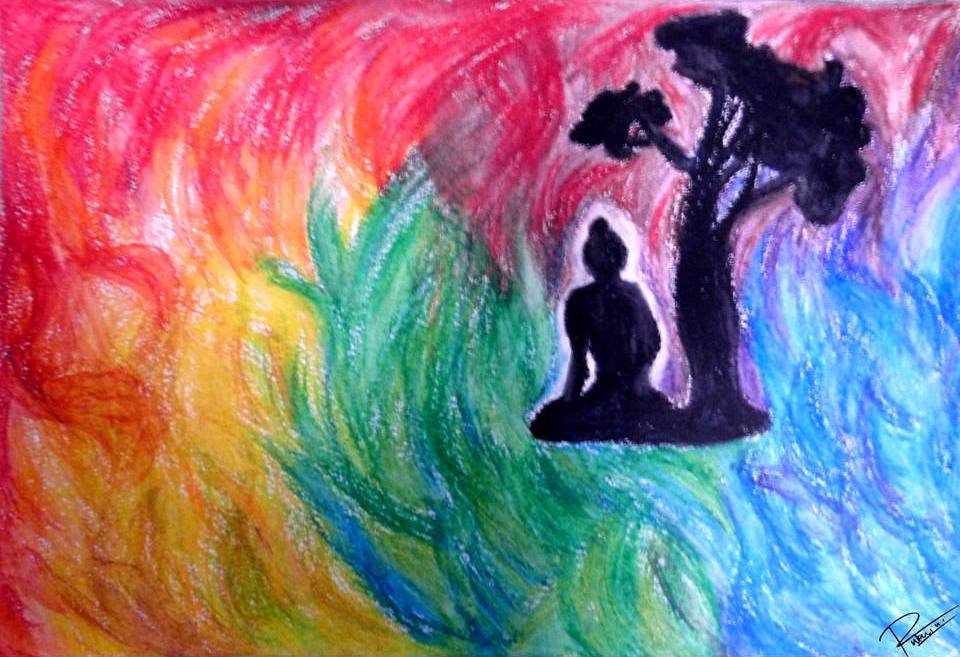
As I started pondering about this blog and formulating thoughts, words deserted me for a while. Colours invaded, instead. Before long, the fingers that fumbled over the keyboard were gingerly handling water-soluble oil-pastels, a medium that I am not used to painting in. And a blog emerged in this form:


My stint here, so far, as a Rotary Peace Fellow at the Chulalongkorn University in Bangkok, has reinforced a few questions that have perhaps been the drivers of my choices thus far in life. Much as I’d prefer answers to pave the way, it is often questions that make us tread the paths that we do, in the process, revealing us to ourselves.

So, the painting has multi-coloured flames surrounding the Buddha – the enlightened one. I chose fire as the element for various reasons. At a mundane level, fire is associated with violence and destruction. From a historical perspective, it stimulates growth by enabling cooking, industry, etc. From a spiritual standpoint, it is often referred to as the cleanser – that which purifies energies. It symbolises light and power. In summation, it seems to encompass all associations from the very negative to the very positive. Hence the varied hues of the flames.

And then there is the Buddha under the Bodhi tree (the tree of enlightenment). He is represented in black, the colour that absorbs every other, be it the passionately violent red or the serenely tranquil blue. The tree symbolises the concept of the Buddha as an entity like you and me, rooted to the Earth, standing firm against the vicissitudes of time, responding to the seasons, making every effort to bloom and bear fruit, and of course, provide the comforting shade of compassion and love. The enlightened one is not in denial of the raging red or passionate pink or the flaming yellow, nor of the luxuriant green or the calming blue or the alluring violet. No need or emotion or desire is good or bad. It simply is. Absorbing all of it into the non-judgmental black was the Buddha’s pathway to peace: absolute acceptance of self and therefore, of the world around. Often, blessings across the world have something to do with ‘being in the light’. In the Buddha’s case, the light is within.

The painting was my mind’s response to thoughts on peace amidst conflict. I choose, at this point, to deal with it at the level of the individual. I have no idea how to govern a country, let alone aim at world peace. Nevertheless, I do believe the macrocosm mirrors the microcosm, and hence the power of one is infinite.

So, what causes conflict within us as individuals? Ironically, often the very first lesson we are taught is a huge blow for the peace within. We are taught not to accept ourselves. As a girl child, I was told by parents trying hard to be liberal, “You are like my son.” The message I got was that it was not good enough to be a girl, one had to be ‘like a son’ to be of any value. School teachers often try to encourage us by comparing us to all and sundry who are better than us at something or the other, telling us we are not ok as we are. The competition in the university systems and the job market keep reinforcing our ‘areas of improvement’. In a world, whose systems we have willfully created, that continually screams non-acceptance at us, how are we to respond, but with inner conflict?

We try to mask this inner conflict by judging others as being not acceptable – the colour of his skin is too dark, she has conservative beliefs, he is too selfish, she is too career-oriented – all of this, to simply battle all that we do not accept in self, in some form or the other. If it were a quality that we accepted in ourselves, seeing it in others would not make us react, for then we would understand. It is only when we do not acknowledge and/or accept something in self, that we react to those things in others. Irritation is our mind calling attention to unaccepted aspects of self.

We find peace as individuals when we accept ourselves and celebrate us for who we are. Acceptance is not passivity. It is empowering. It is the first step to change and growth. Denial stalls change, for we do not admit the need for growth. Peace is a conscious choice.

My wish-list for world peace is simple: if only we held babies tight against our chests, regardless of their sex; if only we appreciated children for their efforts at learning, regardless of their grades; if only we hugged those that care, regardless of their economic class; if only we were grateful for love, regardless of who it came from; if only we shared in trust, regardless of who returns the trust and in what form; if only we respected the Mother Earth, who holds us to her bosom regardless of what we have been doing to her… we will know peace, in that moment.

In the meanwhile, our hope is the harbinger of peace. The flowers that bloom every spring, the bird that builds a nest after every storm, the naked street children that wear a big smile without knowing where their next meal will come from, the mothers that give birth in refugee camps – all remind us that peace is the destination of a conflicted world, and therefore, we must hope.

I am reminded of the words of the renowned Hindi poet Harivanshrai Bacchhan: “Need ka nirmaan fir-fir, neh ka ahvaan fir-fir…” Yet again one builds a nest, yet again there’s the call of love…

Sunday, March 10, 2013

Dawn


We strive for an identity,
Believing life is the sum of accolades gathered;
Till life heaves a sigh
And gently smiles, revealing…
We are to break the identity,
To go beyond what we think we are.
Life now is not to gather, but to give up;
It's about claiming oneself and claiming all.
This claim demands relinquishing
All that was us, to now be us,
To wrench away from the image of God
To ultimately, be God.

Thursday, March 07, 2013

What's in a name?

One sees, and wants to name...
What is it about us
That wishes and rushes to identify and define?
Is it our physicality that merits a definition;
Or is it the mind's eye trapped in the physicality?
Wonder how would it be in a world without names...
Would we blend and grow with abandon
For there would be none to call us small;
Would we love and merge with no boundaries
For there would be none to outline borders;
Would we see perspicaciously that we are one
For there would be none that is named God...
One does not know, for this is a world with names
Perhaps we hope that our names are the pathway to God.
That Name, which encompasses existence
And non-existence too,
For in naming, we acknowledge the un-named.
In this realm of names
Our journey seems to start with being the named
To claiming that in us which is un-named.
The named and the nameless indulge in the cosmic dance
Merging, dividing... Orchestrating the orgasm that is life
Till the named surrenders
The nameless graciously consumes
To birth another symphony
To be dedicated to yet another name...

(Inspired by and dedicated to a nameless two-day old kitten :) )

Thursday, August 18, 2011

Contentment is Embrace

An oft-misinterpreted aspect of spirituality is the idea of contentment. It is usually understood to mean being satisfied with whatever one has. This sometimes borders on being complacent and forcing oneself to be happy with mediocrity.

Contentment is certainly not about being impervious to quality of life. It is quite the antithesis. It is, in fact, a powerful technique of transformation. To be content means to embrace one’s given situation the way it is. Once we do it, once we accept our reality, we merge into it. In that merger lies the power to transmute the reality.

So let us say we are not happy with our financial condition. Contentment is not about resigning to it and living in relative poverty. In resigning to it, we reject the situation and are unhappy. The idea of giving in to what one has as ‘fate’ is merely lip service then. Internally, we keep feeling bad about the situation and sometimes, go to the extreme of perceiving the people who are better off as being materialistic and unspiritual.

There is nothing unspiritual about being happy and abundant. Happiness, emotionally and materially, is an expression of one’s energy. It is a reflection of the value one creates. Therefore, if one is not content with a financial situation, the first step is to accept the situation and do a candid review. Then assess one’s potential so as to figure out the resources that can help to bridge the gap between the situation and the aspiration. And there are always internal resources, regardless of age, gender or any other parameter. Sometimes it is merely a matter shaking off that intrinsic lethargy that we may not be aware of. Once that is done, the path opens up to change.

Thus, contentment is not about resignation. It is about surrender, so as to release any sense of rejection we may have towards the situation. Embrace facilitates change. Acceptance is the key to empowerment.

Wednesday, July 13, 2011

As an Indian woman who’s hit the three decade mark recently, I am often treated as being doomed. Doomed, because apparently one of the qualifications for success when you are 30 is to have a ‘successful’ married life, perhaps, with a couple of kids thrown into the picture. So, I am often subjected to rather nosy remarks disguised as condolences about my single status. And on the rare occasions that I bother to respond and tell the person I am happy and single by choice (and honestly so), the counterpoint is an ominous “You don’t realise it now, but who will take care of you in your old age? All your friends will get busy with their spouses and children, and you will be left alone…” Really? I don’t particularly bother to retort and tell them the truth about my many frustrated married friends. And when did marriages start coming with an insurance contract for being taken care of in old age?

Let me state here that I am not a misogamist. I am certainly open to the idea of sharing one’s life with a partner if and when one feels like it. But the point of contention is the concept of marriage and family in conjunction with human evolution.

Over millennia, we have evolved physically, mentally and consciously. The evolution of consciousness, individually and collectively, has resulted in development that includes the formation and continual alternations of personal and social relationships. We have moved from being scared, suspicious primates to ferocious, insecure warriors to intellectual, civil technologists, and parallelly, bigoted, rigid fundamentalists. At every stage in this evolution of consciousness, we have seen our social structure change. From the tribal instinct of conquering a partner using physical prowess to the supposedly secure institution of marriage, we have tried to ensure that more and more relationships are based on love rather than mere biological or monetary reasons.

At this point, let us dwell on our understanding of consciousness. In my opinion, it is the force that keeps us alive, makes us use our body and do the things we do in our lives. It is our bridge to divinity. Evolution of consciousness entails increasing awareness of it. In our primal stages, we understood consciousness as a scary unknown (the fearsome, punishing God) that controls us. We eventually moved to mirroring it outward as an external entity (the judging God) that influences us and thus instituted the concepts of religion and worship. Now, we acknowledge, to a great degree, that it is not external, but within us (Love Incarnate). Hence, we find a lot more people being open to ‘new age’ philosophies and practices.

With this change, we also see its reflection in the social patterns of individuals and communities that are more aware. These people choose to base their relationships, actions and work on love. Love acts as the guiding force of their existence. Therefore, the conventionally conditioned need for guarantees in a relationship is minimised. They understand that commitment is merely an insurance against change. By its very nature, it is a fallacy, since change is constant. If we expect our partner to not change, what we expect is for him/her to stop growing. This goes against the very purpose of existence.

One may have a couple of questions now: Firstly, if commitment is unnatural, is philandering our birthright? Secondly, when we speak of some people being more aware and the others still preferring the fortress of imposed loyalty and duty towards spouse and family, are we being separatist and judgmental and categorising people as being superior or inferior?

To answer the first question, no, philandering is simply an individual choice and tendency, not a birthright. If one wishes to use this choice, one has to be ready for the repercussions. Let us go back a few steps and understand the idea of commitment. Conventionally, commitment is understood to mean not changing one’s stance and attitude towards a partner. Now if we as individuals evolve and so do our partners (at different paces), the equations in our relationships are bound to change. If we do not acknowledge and adapt to these changes, the relationship will get uncomfortable. It is as good as not respecting the reality about yourself and your partner. Typically, in a commitment-oriented relationship, after the initial months or years, the romance fizzles off and relationship is sustained due to a sense of duty and obligation. And then it sours, since it is naturally difficult to live an enforced obligation all our life.

The only thing we can be committed towards is change – change towards growth. And since we can control only our personal growth, the only commitment really possible is towards oneself. This is a commitment of true love, for it is love that propels us to live and grow. So what we need to look for in a relationship is not a person who can commit to us, but who is committed to self. For one can only give what one has. If one loves self, then one can love another. In such a relationship, cheating and hurting a partner intentionally is naturally not possible, since the person would realise that what s/he does to the other, s/he does to self.

A relationship based on these values is not a lifetime guarantee or legal stamping, but it is about propelling the growth, joy and love for all involved. The nature of the partnership may change with time, since the partners would allow space for growth, and perhaps, people may decide to part ways. But this parting is merely an output of love; it is about saying, “I recognise the need to release you for your growth and mine. I do so with the trust that our new paths will bring us both joy and more love.” It is about recognising that love is too magnificent a force to be restricted ‘exclusively’ for one person.

Now, the second question: are we being judgmental when we talk of some people being more aware than others? No, it is simply about living our truth. The way we live reflects our connect with the divine – our higher selves. If we are aware of the magnitude of love that we are, we would be lying to ourselves if we complied with existing social norms simply due to fear. Our beliefs, thoughts and actions need to be aligned for us to be honest to self. The truth differs from one person to another, for it is our understanding of our consciousness. So there is no superior or inferior, all is a reflection of God, of Love. What is paramount is living our own truth and not a socially convenient one.

So if we wish to get married at a certain age because society dictates so or produce kids to make our parents happy, we may wish to have a reality check. Are we complying out of fear or obligation? Because ‘everyone’ does so? Are we too scared to even think of an alternative choice? If yes, we are wasting a lot of our time and effort in living a lie. We may fool ourselves into believing that we’ve compromised and ‘sacrificed’ and made others happy in the process. But when we are living a lie, everything that is a part of that lie is an illusion. We may pretend to be happy, others may pretend to be satisfied with us, but what have we really given others? Just a pretence…

Social norms such as legal marriages, the pressure to produce kids, etc. were evolved in an era that perhaps needed the rigidity to help us understand love. It is like how we need the discipline of a school to help us have a strong academic foundation. But now, we have moved on. If we continue to live in the same schools, we will suffocate and not learn. This is not to say marriages are unnecessary and having children is not required. But yes, it may not be everyone’s need. When it is not, it is important to state our truth by living it. That is the only way to live our purpose. Getting married or having children does not make us complete. We are complete in ourselves. Any social relationship is merely a recognition and celebration of that completion.